
Table of Contents
A supplement company can be founded with just one product. It might be a tablet or powder that is mixed into a drink. However, as soon as orders start to come in from other areas, the business side becomes more complex. Where should the products be made? Is shipping them halfway across the world worth the cost? And what happens when orders suddenly increase?
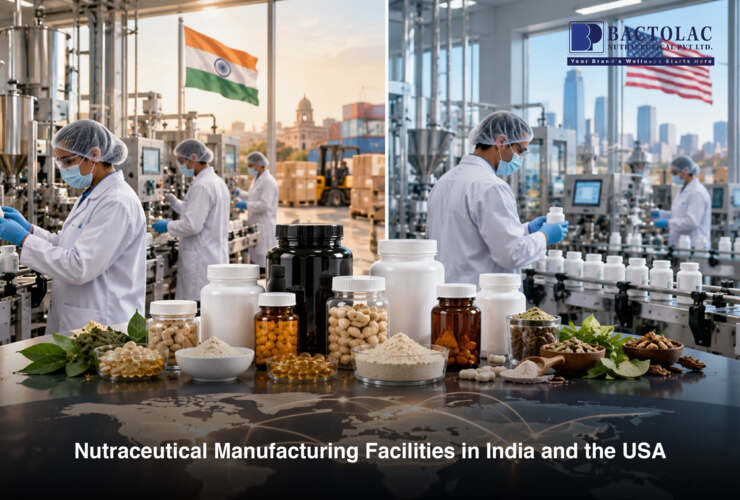
These are the sorts of questions that make nutraceutical manufacturing in India and the USA worth exploring. Both countries have something to offer, but not necessarily the same thing. And for a business hoping to sell internationally, that difference can be useful.
Why Many Businesses Look at India First
One reason companies consider India is fairly straightforward: manufacturing costs can be lower than in some other markets. That doesn’t mean every product will automatically be cheaper to make here. Ingredients, order quantities, packaging, and the type of supplement all affect the final cost.
Still, India has a well-established manufacturing sector, and businesses can find facilities making different kinds of supplements. Capsules, tablets, powders, vitamins and herbal products are all part of the picture.
For a brand planning to sell several products, finding a nutraceutical manufacturer in India that handles different formulations can save time. There is less need to approach a new supplier every time the product range changes.
At Bactolac Nutraceuticals, we work with businesses looking for manufacturing support across different supplement categories.
The USA Has Its Own Advantages
Now, imagine a company whose customers are mostly in the United States. Its products are selling well, but every order has to travel from India. Shipping takes time, customs can slow things down, and the business has to plan stock well ahead.
In that situation, manufacturing closer to the customer might be worth considering.
The USA has a large market for dietary supplements, from everyday vitamins to sports nutrition products. Local production can help some brands manage orders and distribution more easily, although the actual benefits depend on the manufacturer and the way products are delivered.
Of course, nutraceutical manufacturing in the USA can come with higher operating costs. For a business working with tight margins, that matters. For another business, the convenience of local production may justify spending more.
There isn’t one answer that works for every brand.
Why Choose Between India And The USA?
Sometimes, the decision doesn’t have to be one country or the other.
A business might find that making certain products in India works well financially, while producing other products in the USA makes more sense for its American customers. Another company might start in India and explore overseas manufacturing only after its sales grow.
That flexibility is one of the useful things about global nutraceutical manufacturing. A company can look at its actual needs instead of trying to make one manufacturing arrangement work for every product. Expanding into international supplement manufacturing allows brands to adapt quickly to different market demands.
Companies that leverage global nutraceutical manufacturing networks can maintain higher production efficiency and reach diverse markets seamlessly.
It goes without saying that it will be slightly harder to manage production between countries. Specifications and regulatory issues are still important, but using two plants is justified only if the deal is beneficial and reasonable enough.
What Happens When Supply Gets Disrupted?
This is something businesses don’t always think about when everything is running smoothly.
An ingredient might become expensive. A shipment could get delayed. A product that usually sells slowly might suddenly become popular, leaving the company short of stock.
When everything depends on one manufacturing location, there may not be many alternatives.
Having access to another suitable facility can give a business more room to respond. It won’t solve every supply problem, but it may help prevent one delay from affecting the entire operation.
A global supplement supply chain needs a little more thought than simply finding the cheapest manufacturer. Businesses have to consider ingredient availability, shipping charges, customs, delivery schedules, and the rules that apply in each market.
These details aren’t particularly glamorous, but they can make a real difference to everyday operations.
Finding A Manufacturer That Fits
The manufacturing partner matters just as much as the country.
A small brand developing its first supplement may need help with formulation and packaging. An established business might already know exactly what it wants and simply need a manufacturer that can handle larger orders.
This is where a contract supplement manufacturer can be useful. Rather than building a factory and managing every stage of production, a brand can work with an existing facility.
There are a few practical questions worth asking before you sign an agreement:
- Is the manufacturer able to handle the product format and volume required?
- What quality checks and testing are done?
- Do you provide packaging, labelling, and other services?
- What if the business has to increase production later?
At Bactolac Nutraceuticals, we offer manufacturing services for a range of supplements, including powders, capsules, tablets, vitamins, and herbal products.
How Bactolac Nutraceuticals Works With Supplement Brands
At Bactolac Nutraceuticals, we understand that a business doesn’t always want to coordinate five different suppliers just to get one product ready for sale. It can become a lot to manage, especially when there are orders, packaging decisions, and production schedules to keep track of at the same time.
We provide turnkey contract manufacturing services for nutraceuticals and dietary supplements. Our work covers product development, manufacturing, testing, packaging, and labelling, with services for products such as tablets, capsules, powders, sports supplements, vitamins, herbal supplements, pet supplements, and other nutritional products. We also offer custom labelling services.
We know that brands come to manufacturing with different plans. Some are working on a new product, while others want to add more products to an existing range. We aim to support those needs through our manufacturing services. Our facility holds FSSAI certification, and we place importance on product quality and food safety throughout the process.
For businesses considering India as a manufacturing base, we offer an opportunity to discuss their requirements and explore suitable services.
Conclusion
Production processes in India and the USA do not necessarily mean choosing one of the two countries in terms of superiority. Manufacturing processes need to be analysed in the context of specific companies’ needs.
India could present advantages in terms of low costs and diversified production opportunities. The USA could be a reasonable location for brands looking to manufacture products near their customers in America. Some companies would profit from manufacturing in both locations; other companies would perform well enough with just one of them.
However, in the case of the decision-making process regarding production processes, it is vital to move beyond cost considerations only.
FAQs
1. How does manufacturing nutraceutical products in India compare with manufacturing in the USA?
India may offer lower production costs, while the USA can provide easier access to American customers.
2. How can multi-country manufacturing help nutraceutical brands expand into international markets?
It gives brands more production options and can make serving customers in different countries easier.
3. What role does India play in the global nutraceutical manufacturing industry?
India provides manufacturing facilities and contract production services for various nutritional supplement products.
4. Why do nutraceutical companies consider the USA an important manufacturing market?
The USA has a large supplement market, making local manufacturing useful for brands serving American consumers.
5. How can manufacturing facilities in multiple countries improve supply-chain flexibility?
They provide alternative production options when delays, ingredient shortages, or changing demand affect supply.